


Kitchen Cabinets or Countertops: Which Comes First in Your Remodel?
In every major kitchen renovation, homeowners eventually face the ultimate sequencing question: which comes first, the cabinets or the countertops? It’s the kitchen remodeling equivalent of the chicken-or-the-egg debate, but unlike the philosophical classic, this question has a definitive, non-negotiable answer backed by decades of professional experience. The answer is always, unequivocally, the cabinets.
Think of your kitchen in two parts: the skeleton and the jewelry. Your kitchen cabinets are the foundational skeleton. They define the room’s layout, create its structural support system, and dictate the placement of every other element. Your countertops are the stunning jewelry. They provide the durable, beautiful work surface that completes the aesthetic. Just as you wouldn’t wear a diamond necklace without a solid frame to support it, you must never install countertops before your cabinets are perfectly and permanently in place. This proper kitchen renovation order of operations is crucial for ensuring structural integrity, achieving a flawless finish, and protecting your significant investment.
Why Kitchen Cabinets Must Be Your First Priority in a Remodel
Putting cabinets first isn’t just a matter of preference; it’s the cornerstone of a successful kitchen remodel. They are the foundational elements that establish the entire room’s functionality and flow long before any decorative surfaces are considered. Rushing this stage or getting the sequence wrong will lead to a cascade of compromises and costly errors down the line.
Defining the Kitchen’s Core: From Layout to Storage
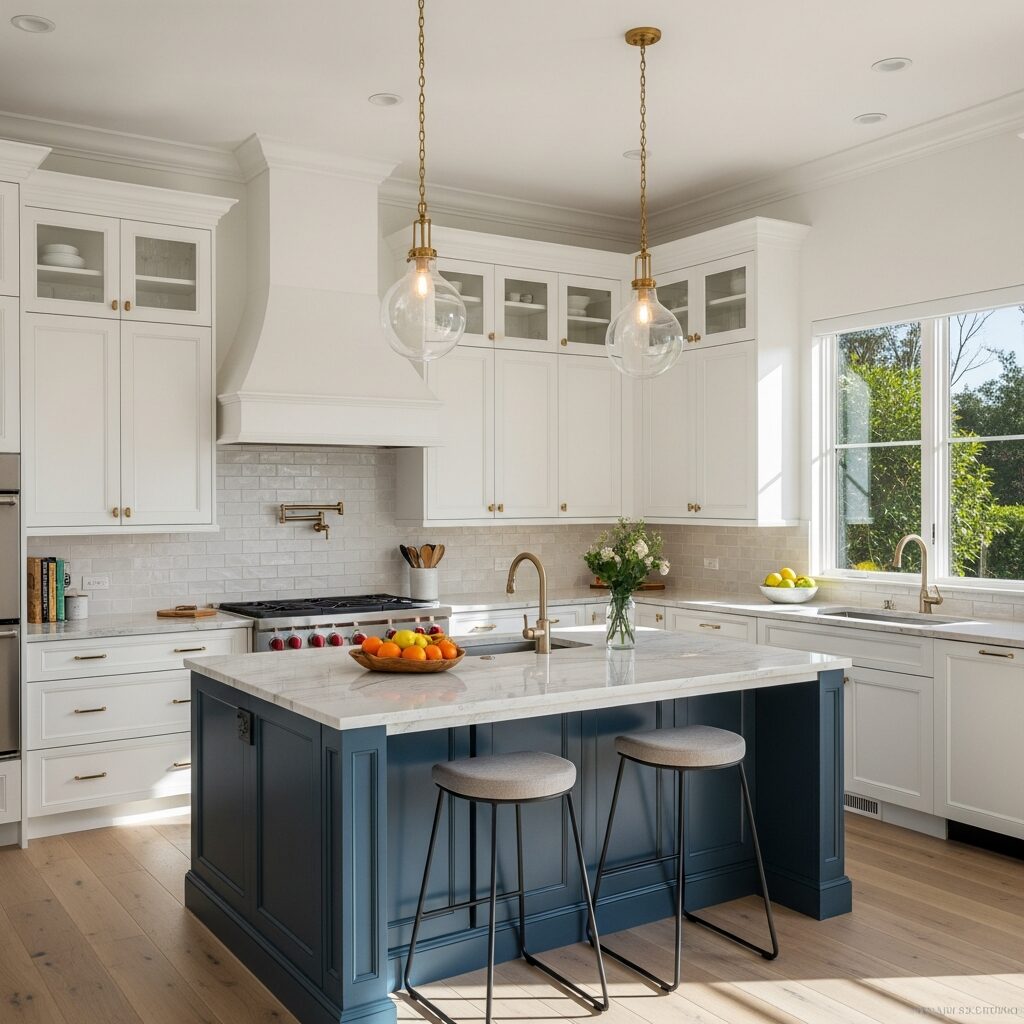
Your cabinets are the building blocks of your kitchen’s floor plan. Their placement determines traffic patterns, workspace efficiency, and overall storage capacity. Whether you envision a grand central island, a functional galley layout, or an open-concept U-shaped design, the cabinet installation sets these boundaries in stone. This is the stage where we map out every inch of your space, ensuring your final layout is as practical as it is beautiful. Choosing the right style and configuration of your custom kitchen cabinets is the first major decision that will influence every subsequent choice in your kitchen design sequencing.
Impact on Plumbing and Electrical Rough-Ins
Before walls are closed up, plumbers and electricians need to know precisely where fixtures and appliances will live. The exact location of your sink base cabinet dictates the placement of water supply lines and drains. The position of your refrigerator, dishwasher, microwave, and range determines where electrical outlets and dedicated circuits must be run. Installing cabinets first provides a fixed, physical map for these trades, ensuring that plumbing and electrical systems are placed with millimeter accuracy. Attempting to install countertops first would be pure guesswork, inevitably leading to expensive and invasive rework.
Ensuring Optimal Workflow and Ergonomics
A well-designed kitchen is built around the “work triangle”—the relationship between the sink, refrigerator, and cooktop. The layout of your cabinetry is what creates this triangle and ensures an ergonomic, efficient workflow. We strategically place cabinets to minimize steps between key tasks, create logical zones for prep, cooking, and cleaning, and ensure that counter heights and depths are comfortable for you and your family. This foundational planning during the cabinet phase is what transforms a collection of boxes and appliances into a truly functional and enjoyable culinary workspace.
Understanding the Structural Foundation of Your Kitchen Renovation
Beyond layout and workflow, the most critical reason for the “cabinets first” rule is structural. Countertops, especially those made from natural stone or quartz, are incredibly heavy. They require a perfectly level, stable, and continuous base for support. Your cabinetry provides this essential structural support for your kitchen remodel, and installing it correctly is paramount to the longevity of your entire kitchen.
Cabinetry as the Skeleton: Weight Distribution and Support
A typical slab of 3cm granite or quartz can weigh between 20 to 25 pounds per square foot. Across an entire kitchen, this adds up to hundreds, sometimes thousands, of pounds of weight. Your cabinets are engineered to bear this immense load and distribute it safely across the floor structure. Each cabinet must be installed perfectly level with its neighbors to create a single, unified plane. Any deviation or instability in the cabinet installation can create stress points in the countertop, leading to cracks and fissures over time—a catastrophic failure for a high-value material.
Floor Leveling and Wall Preparation for Cabinet Installation
No home has perfectly level floors or perfectly plumb walls. Before a single cabinet is hung, a professional remodeler will assess and prepare the substrate. This involves leveling the floor where the base cabinets will sit and ensuring the walls are flat and have adequate blocking within the framing. This preparation ensures that cabinets can be installed without rocking or twisting, providing a solid foundation. Scribing cabinets to fit the contours of an uneven wall is a critical skill that guarantees a seamless, integrated look and a stable base for the countertops to follow.
Anchoring Cabinets for Long-Term Durability
Proper cabinet installation before countertop placement involves more than just setting boxes on the floor. Each cabinet must be meticulously shimmed to be perfectly level and plumb, then securely anchored to the wall studs with specialized screws. Base cabinets are also fastened to one another, creating a single, monolithic unit. This robust anchoring prevents the cabinets from shifting, sagging, or pulling away from the wall under the heavy, constant load of the countertops and the daily rigors of use. This is what guarantees your kitchen will remain beautiful and functional for decades.
The Seamless Finish: How Cabinet Placement Elevates Countertop Installation
With a perfectly installed cabinet base, the path is cleared for a flawless countertop installation. The precision established during the cabinet phase directly translates into the high-end, seamless finish every homeowner desires. This is where the “jewelry” is fitted to the “skeleton.”
Accurate Measurements and Custom Fabrication
Countertops are not an off-the-shelf product; they are custom-fabricated for your unique kitchen. After the cabinets are fully installed, a specialist creates a precise digital or physical template of your cabinet layout. This template captures every exact dimension, angle, and cutout requirement for your sink and cooktop. The fabrication team then uses this template to cut your chosen slab of quartz, granite, or other material to tolerances within a fraction of an inch. This process is only possible once the cabinets provide a fixed, unchanging landscape to measure.
Preventing Gaps and Uneven Surfaces
When cabinets are installed correctly—level, plumb, and securely fastened—the resulting surface for the countertop is a perfect plane. This eliminates the risk of unsightly gaps between the bottom of the countertop and the top of the cabinets. It also ensures a smooth, continuous work surface with virtually invisible seams. A level base is crucial for preventing lippage, where one section of the countertop is higher than the adjoining piece at a seam, creating an uneven and unprofessional finish.
Integrating Sinks and Appliances Flawlessly
The modern, clean look of an undermount sink is only possible with a precise cutout in the countertop material. This cutout must align perfectly with the sink base cabinet below it. Similarly, slide-in ranges and cooktops require specific dimensions to fit snugly between two sections of countertop. By installing cabinets first, we guarantee these appliances and fixtures integrate perfectly, creating the sleek, built-in aesthetic that defines a high-quality kitchen renovation.
Planning Your Kitchen Remodel: A Step-by-Step Guide
Understanding the correct kitchen remodeling priority is key to a smooth process. A professional remodeler will follow a proven sequence to manage remodeling timelines and deliver exceptional results. Here is the proper order of operations for a major kitchen project.
- Initial Design Consultation and Material Selection: This is where the vision takes shape. We work with you to finalize the layout, select cabinet styles, and choose countertop materials, flooring, and fixtures. For ideas, you can explore our kitchen inspiration gallery.
- Demolition and Site Preparation: The old kitchen is carefully removed, and the space is prepared. This includes any necessary framing, plumbing, or electrical rough-in work based on the new cabinet plan.
- Cabinetry Installation: Precision and Placement: The foundational “skeleton” of your new kitchen is installed, leveled, and secured, setting the stage for everything to come.
- Countertop Measurement, Fabrication, and Installation: With cabinets in place, precise templates are made. Your chosen countertop materials are then cut and professionally installed.
- Final Touches and Appliance Integration: The final phase includes installing the backsplash, plumbing fixtures, lighting, flooring, and paint. Major appliances are then put into place and connected, completing the transformation.
