

In Southern California’s market, kitchen cabinet and countertop upgrades recover 50 to 60 percent of their cost at resale, while strategic flooring and layout improvements push that recovery closer to 65 to 75 percent when paired with a cohesive design vision. The difference between a kitchen that merely updates and one that genuinely moves the needle on home value comes down to material choice, spatial flow, and restraint.
Most homeowners think ROI means getting every dollar back. That’s not how it works. What matters is recovery rate: the percentage of what you spend that translates into measurable resale value. In Southern California, where the market rewards clean contemporary design and refined finishes, certain upgrades punch above their weight.
Which Kitchen Elements Actually Move Resale Value?
Cabinetry is the anchor. New cabinets represent the visual and functional foundation of any kitchen, and buyers notice immediately whether they’re dated or current. Semi-custom or custom cabinetry in a sophisticated neutral finish, think soft whites, warm grays, or natural wood tones, commands attention without screaming for it. Cabinet upgrades typically recover 55 to 65 percent of cost, making them one of the most reliable ROI plays in kitchen remodeling. The key is avoiding trendy colors or overly ornate hardware that will feel dated in five years.
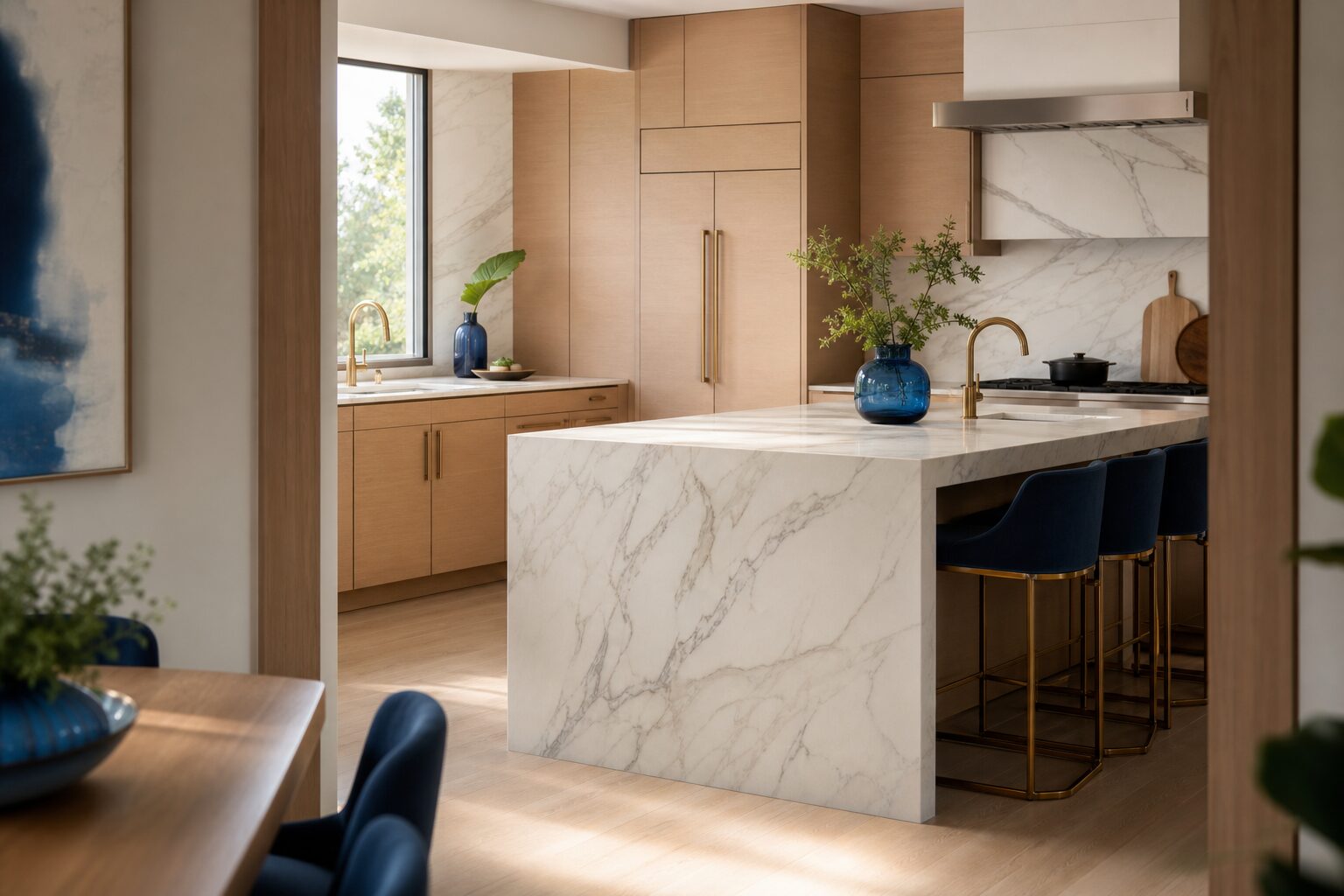
Countertops are the second pillar. Marble, quartz, and high-quality granite appeal to Southern California buyers because they signal both luxury and durability. A polished marble or soft-veined quartz countertop in a bright, airy kitchen reads as intentional design, not just an upgrade. Recovery rates here sit between 60 and 70 percent, especially when the material complements the overall aesthetic rather than competing with it.
Flooring ties the room together and affects perceived quality more than most homeowners realize. Luxury vinyl plank that mimics natural wood, quality tile, or authentic hardwood in a warm tone creates continuity and warmth. Flooring recovery rates range from 50 to 70 percent depending on material choice and condition. Avoid anything that feels cheap or overly trendy; buyers in this market are looking for timeless elegance.
Does Layout and Flow Actually Impact Resale Value?
Yes, but not in the way most contractors pitch it. You don’t need to move walls to improve a kitchen’s perceived value. What moves the needle is openness, light, and a logical work triangle. Removing a non-load-bearing wall between the kitchen and living area, improving sightlines, or reconfiguring the island to enhance traffic flow creates a sense of spaciousness that buyers feel the moment they walk in. Layout improvements are harder to quantify in dollar recovery, but they’re the difference between a kitchen that feels dated and one that feels designed.
In Southern California’s design-conscious market, a thoughtfully reconfigured kitchen with better flow and natural light can add 2 to 5 percent to overall home value when paired with quality finishes. That’s not a massive number, but it’s the halo effect that makes the entire home feel more valuable.
What About Appliances and Fixtures?
Stainless steel appliances are table stakes. Buyers expect them; they don’t wow anyone. A high-end range or cooktop can justify itself if you’re targeting a luxury segment, but standard mid-range stainless recovers only 40 to 50 percent of cost. Fixtures, faucets, lighting, hardware, should be refined and understated. Warm metallic finishes (brushed gold, warm bronze) outperform chrome in Southern California’s current market. These details recover 30 to 50 percent, so choose them for cohesion, not as a primary ROI driver.
How Do You Prioritize When Budget Is Limited?
Start with cabinets. They’re the biggest visual anchor and the most reliable ROI. If your budget allows, pair them with quality countertops in a sophisticated material. Then tackle flooring. These three elements, cabinetry, countertops, and flooring, create the foundation of a kitchen that feels intentional and current.
Layout improvements come next if budget permits, followed by appliances and fixtures. Splurging on a premium range makes sense only if the cabinets and countertops are already elevated; otherwise, it looks like you’re trying too hard in one area.
For a comprehensive breakdown of how these decisions fit into your overall remodeling budget, our Orange County Kitchen Remodeling Budget Guide walks through typical allocations and where to invest for maximum impact.
Does Design Cohesion Actually Matter for Resale?
It matters more than you think. A kitchen with mismatched finishes, competing styles, or elements that don’t speak to each other reads as chaotic, even if each piece is high quality. Southern California buyers in the market for a remodeled home are looking for evidence of a coherent design vision. Warm metallic accents that echo throughout, a consistent material palette, and a clear aesthetic, whether that’s minimalist modern or refined coastal, add perceived value beyond the sum of the parts.
Cohesion doesn’t cost more; it requires restraint and intentionality in material selection. Choosing three to four finishes and sticking to them feels more expensive than choosing eight.
Pro tip: Photograph your finished kitchen in natural light. Bright, airy spaces photograph beautifully and influence buyer perception before they even walk through the door. In a market where design matters, good photography is part of the ROI strategy.
What About the Broader Home Remodeling ROI Picture?
Kitchen remodeling doesn’t exist in a vacuum. If your home also needs bathroom updates or flooring consistency throughout, addressing those together creates a narrative of a well-maintained, thoughtfully updated home. For a deeper look at how kitchen and bathroom remodeling work together to maximize home value, see our piece on Maximizing Home Value Through Kitchen and Bathroom Remodeling in Orange County.
The highest ROI kitchens in Southern California are those that feel like part of a larger design strategy, not isolated upgrades. If your kitchen is stunning but your bathrooms are dated, or your flooring is inconsistent, the kitchen’s impact is diluted.
How Much Should You Actually Spend?
The rule of thumb is that a kitchen remodel should not exceed 10 to 15 percent of your home’s current value. In Southern California, where home values are high, that gives you real budget to work with. A $100,000 kitchen remodel on a $1 million home is reasonable; a $200,000 remodel on the same home is likely over-investing relative to recovery.
Focus on recovery rate, not total dollars spent. A $60,000 kitchen that recovers 65 percent ($39,000) is a better investment than a $100,000 kitchen that recovers 50 percent ($50,000) if the first one is better designed and more cohesive.
For a detailed framework on balancing budget with value, our Home Remodeling ROI Guide for Kitchen, Bathroom, and Flooring breaks down typical cost allocations and recovery expectations across different remodeling scenarios.
Frequently Asked Questions
What kitchen upgrade has the best ROI in Southern California?
Cabinetry combined with quality countertops delivers the most reliable ROI, recovering 55 to 70 percent of cost. These two elements are the visual anchors buyers notice first and affect perceived quality throughout the entire kitchen. Pair them with good flooring and thoughtful lighting, and you’re looking at a kitchen that justifies its investment.
Should I replace cabinets or refinish them to save money?
Refinishing is a cost-saving measure, but it reads as a cost-saving measure. New cabinetry in a sophisticated finish signals investment and care. If budget is tight, refinishing can work, but it typically recovers 35 to 45 percent of cost compared to 55 to 65 percent for new cabinets. New is the better ROI play if you can manage it.
Does an open floor plan add more value than a closed kitchen?
In Southern California, yes. Buyers prefer open, bright kitchens that flow into living spaces. Removing a non-load-bearing wall between kitchen and living area, if feasible, can add perceived value. However, structural changes are expensive and carry risk. Focus on improving sightlines and traffic flow first before considering major layout changes.
What flooring material recovers the most value?
Quality hardwood and luxury vinyl plank that mimics natural wood recover 60 to 70 percent of cost in Southern California. Tile recovers 50 to 65 percent depending on quality and design. Avoid cheap laminate or anything that feels temporary; buyers equate flooring quality with overall home quality.
Is it worth upgrading to a luxury appliance brand?
Mid-range stainless steel appliances are expected; they recover 40 to 50 percent. Premium brands recover slightly more, but the difference is modest relative to the cost premium. Invest in appliances that are reliable and visually cohesive with your cabinetry, not in brand prestige alone.
How long does a kitchen remodel typically take?
A full kitchen remodel with new cabinets, countertops, and flooring typically takes 6 to 10 weeks, depending on scope and whether structural changes are involved. Custom cabinetry can add lead time. Plan for disruption and budget for contingencies; most remodels encounter surprises once walls are open.
What’s the difference between semi-custom and custom cabinetry for ROI?
Semi-custom cabinetry offers good design flexibility and quality at a mid-range price point, typically recovering 55 to 65 percent of cost. Custom cabinetry allows full personalization but costs more and recovers at similar rates unless you’re in a luxury market segment. For most Southern California homes, semi-custom is the ROI sweet spot.
