
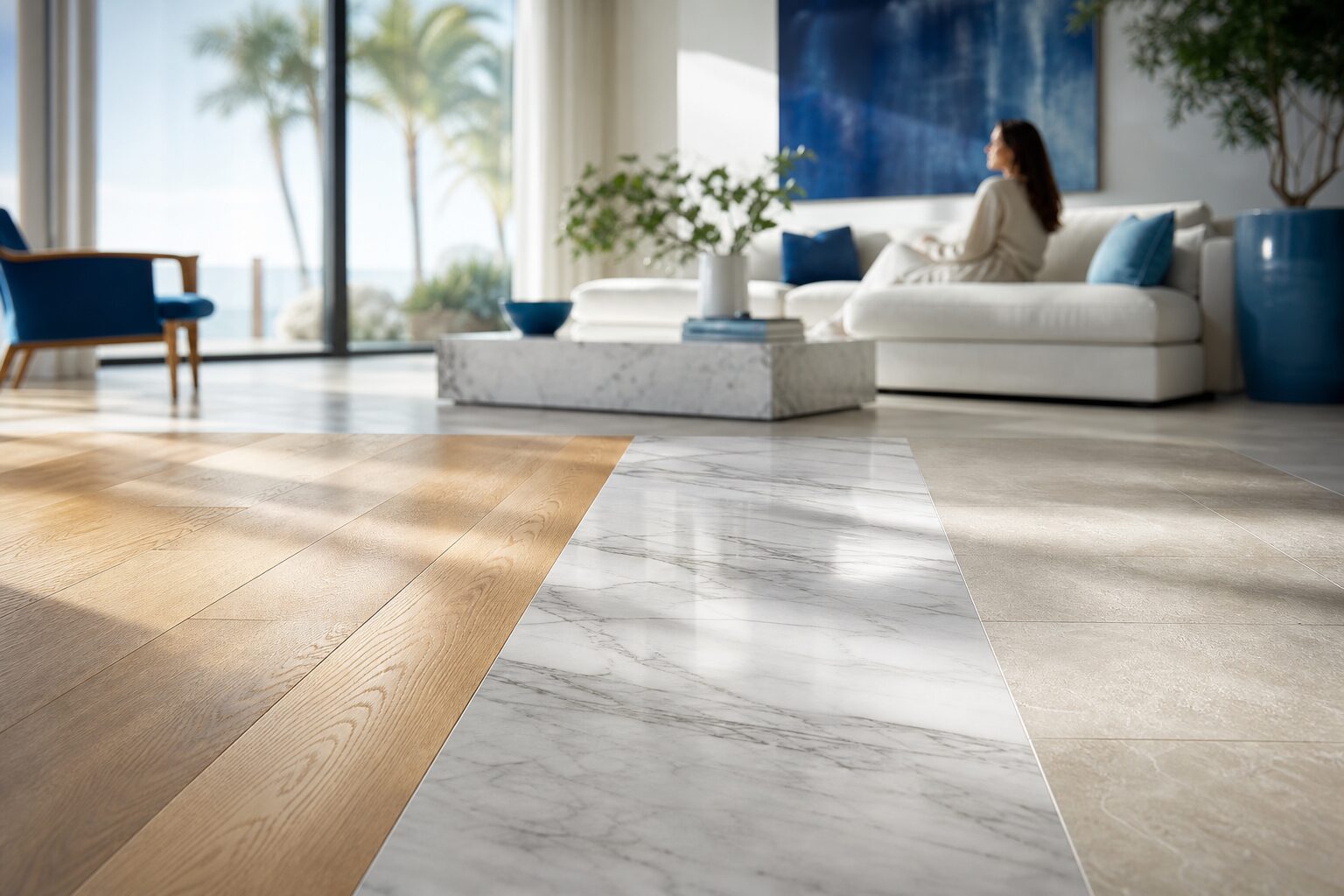
For Southern California homes, luxury vinyl plank (LVP) and hardwood dominate the market, while tile holds its own in specific zones. The choice depends less on which material is objectively best and more on how you actually live in your space, what your climate demands, and how much maintenance you’re genuinely willing to do.
What’s the Real Difference Between These Three Materials?
LVP is engineered to mimic hardwood or stone using a photographic layer atop a plywood or composite core. Hardwood is solid wood, typically 3/4 inch thick, sanded and finished. Tile is fired clay, porcelain, or natural stone, set in mortar. The material you choose shapes everything: installation cost, longevity, feel underfoot, and how your home weathers Southern California’s dry heat and occasional moisture.
LVP wins on affordability and water resistance. Hardwood wins on warmth, resale perception, and timeless aesthetic. Tile wins on durability in wet zones and high-traffic commercial-style spaces.
Durability: Which Material Actually Lasts in a California Climate?
Hardwood can last 25 to 30 years with proper care, but Southern California’s low humidity and intense UV exposure demand attention. Direct sunlight fades stain and causes cupping or shrinkage. You’ll need to refinish hardwood every 7 to 10 years in high-traffic areas. Wide plank European oak, increasingly popular in California homes, handles movement slightly better than narrow planks, though the trade-off is cost.
LVP typically lasts 15 to 20 years before wear becomes visible. The wear layer (the protective top coat) is the critical factor. Premium LVP with a 20-mil wear layer outperforms budget options significantly. Water resistance is LVP’s superpower: spills and minor flooding don’t ruin it the way they ruin hardwood.
Tile is virtually indestructible in terms of material integrity. Porcelain tile lasts 50 years or longer. The real vulnerability is grout. Unsealed grout stains and cracks. Sealed grout holds up better, but resealing every 3 to 5 years is the honest maintenance commitment.
For a coastal California home exposed to salt air and humidity, LVP or tile outperform hardwood. Inland, with controlled humidity, hardwood thrives.
Cost: Installation, Material, and the True Price Tag
Material cost alone tells an incomplete story. Installation labor in Southern California runs $8 to $15 per square foot for all three options, depending on subfloor prep and complexity. Hardwood sits highest: $12 to $20 per square foot for material, plus labor. Wide plank European oak flooring trends in California push that figure higher, especially for premium grades.
LVP ranges from $3 to $12 per square foot for material. Installation is straightforward, often the cheapest labor cost of the three. Total installed cost: $12 to $25 per square foot.
Tile varies wildly by selection. Basic porcelain runs $5 to $10 per square foot. Natural stone or large-format designer tile climbs to $15 to $30 per square foot. Installation is labor-intensive, especially for intricate layouts or large-format tiles. Total installed cost: $15 to $40 per square foot.
For a 2,000-square-foot kitchen and adjacent living space, budget $24,000 to $50,000 for hardwood, $24,000 to $50,000 for premium LVP, and $30,000 to $80,000 for designer tile. The gap narrows when you factor in long-term replacement cycles.
Maintenance: What You’ll Actually Do Every Month and Year
Hardwood demands discipline. Sweep weekly. Wipe spills immediately. Avoid standing water. Use a hardwood-specific cleaner monthly. Refinishing is non-negotiable every 7 to 10 years in high-traffic zones. Some homeowners embrace this ritual. Others resent it.
LVP is the low-maintenance choice. Sweep, vacuum, and damp-mop. No special cleaners required. No refinishing. The trade-off is that deep scratches or gouges cannot be repaired; you replace the plank. For families with pets or young children, this simplicity is worth the aesthetic compromise.
Tile requires regular grout maintenance. Sweep and mop weekly. Reseal grout every 3 to 5 years. Mold can develop in grout lines in bathrooms or poorly ventilated areas. Larger grout lines trap more dirt. Smaller grout lines reduce visual dirt but increase labor during resealing.
Pro tip: If you’re installing hardwood in a kitchen, use a matte or satin finish rather than high-gloss. It hides dust and water spots better, and it feels less slippery underfoot on a damp morning.
Which Material Suits Your Southern California Home?
Kitchens and bathrooms are the test case. Kitchens see spills, moisture, and heavy foot traffic. Bathrooms see standing water and humidity. Hardwood in either space requires vigilance. LVP is the practical choice for kitchens and bathrooms. Tile is ideal for bathrooms, especially shower surrounds and wet zones.
Living rooms and bedrooms are where hardwood shines. These spaces see less moisture and benefit from the warmth and sound-dampening of solid wood. If you’re committed to the maintenance, hardwood elevates the entire home’s aesthetic in a way LVP cannot match.
Entryways and hallways are high-traffic zones. Tile or premium LVP withstand foot traffic better than hardwood. If you choose hardwood here, expect visible wear within 5 years.
For a comprehensive flooring strategy across your entire home, consider a hybrid approach: hardwood in low-moisture living and sleeping areas, LVP or tile in kitchens and bathrooms. This balances aesthetic ambition with practical durability.
When you’re ready to move forward, California Signature Kitchen, Bath & Flooring specializes in exactly this kind of material selection and installation across Southern California homes. We help you navigate the choice based on your actual lifestyle, not just design preference. A consultation with our team clarifies which material makes sense for each zone in your home, accounting for your climate exposure, maintenance tolerance, and long-term vision.
If you want to explore hardwood options in depth, our guide on wide plank European oak flooring trends in California walks through the specific advantages of this increasingly popular choice. For a deeper comparison of LVP and hardwood side by side, read our breakdown on LVP vs. hardwood flooring for Southern California remodeling. And if you’re curious about what’s gaining momentum in the market right now, our spring 2026 Southern California flooring trends piece covers the latest material innovations and design directions.
Frequently Asked Questions
Is LVP a good long-term investment for a California home?
LVP is a solid practical choice, especially for kitchens, bathrooms, and high-traffic areas. It lasts 15 to 20 years with minimal maintenance. The real question is resale perception. Some buyers view LVP as a cost-saving measure rather than a premium finish. If you plan to sell within 10 years, hardwood or tile in visible living areas may hold stronger resale value. If you’re staying long-term or prioritize durability over perceived luxury, LVP is a smart choice.
Will hardwood warp or shrink in Southern California’s dry climate?
Yes, but less dramatically than in humid regions. Low humidity causes wood to shrink slightly, which can create minor gaps between planks. This is cosmetic, not structural. Maintaining consistent indoor humidity (around 40 to 50 percent) minimizes movement. Using a humidifier in winter helps. Wide plank European oak is engineered to handle movement better than narrow planks, making it a popular choice in California homes for this reason.
Can I install tile in a living room or bedroom?
Absolutely. Tile works anywhere. The trade-off is comfort and sound. Tile is cool underfoot (pleasant in summer, cold in winter) and echoes more than wood or LVP. In living rooms, tile feels less warm and inviting than hardwood. In bedrooms, the hardness and sound reflection are less desirable. Tile excels in kitchens, bathrooms, entryways, and laundry rooms where durability and water resistance matter most.
What’s the best way to protect hardwood from UV fading?
UV-blocking window treatments (curtains, cellular shades, or exterior awnings) are the most effective approach. Apply a matte or satin polyurethane finish rather than high-gloss, which shows dust and water marks more visibly. Some homeowners use area rugs to cover high-sunlight zones. Expect some color shift over time regardless; this is part of hardwood’s natural aging character.
How often does grout need to be resealed on tile floors?
Every 3 to 5 years, depending on traffic and moisture exposure. Bathrooms and kitchens need resealing more frequently than living areas. A simple test: if water beads up on grout, it’s still sealed. If water soaks in, it’s time to reseal. Using epoxy grout instead of standard grout extends the interval between resealing, though epoxy is harder to install and more expensive upfront.
Can I refinish LVP if it gets scratched?
No. LVP cannot be refinished. Deep scratches or gouges require replacing the affected plank. This is the trade-off for low maintenance. If you have pets or high foot traffic, budget for occasional plank replacement over time. Premium LVP with a thicker wear layer resists scratching better than budget options.
