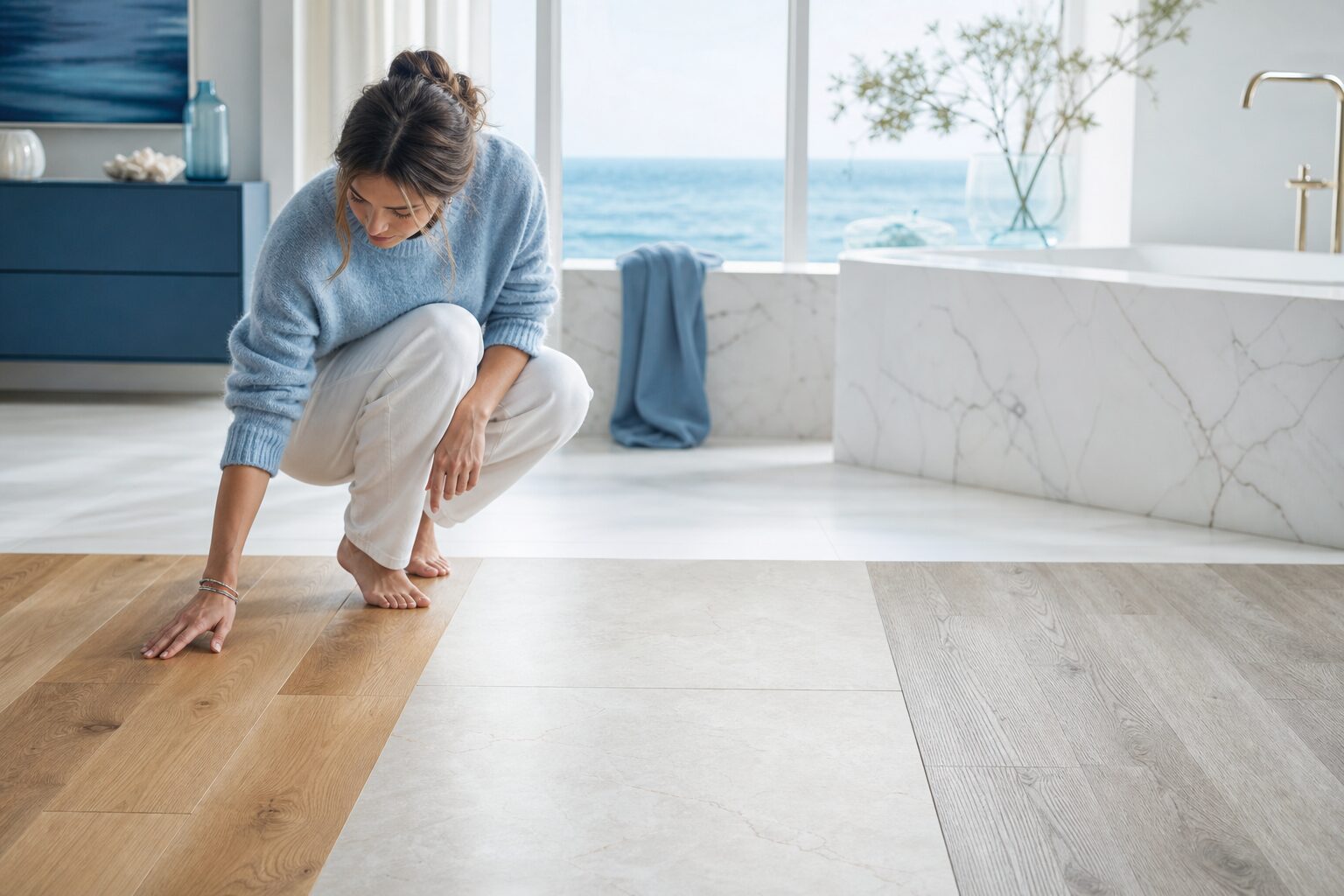
Luxury vinyl plank, hardwood, and tile each solve different problems in kitchen and bathroom spaces, and picking the wrong one wastes money and creates maintenance headaches for years. The choice isn’t about which material is objectively best, it’s about matching the material to your specific room, your household’s actual use patterns, and the aesthetic you’re after.
What Makes Each Material Different
Start with the basics. Hardwood is wood. Tile is fired clay or stone. Luxury vinyl plank (LVP) is a multi-layer engineered product with a photographic wood or stone layer on top, a plywood core, and a waterproof backing. Each behaves differently under moisture, foot traffic, and heat.
Hardwood brings warmth and timeless elegance, but it’s the most vulnerable to water and the most demanding to maintain. Tile is nearly indestructible and handles moisture beautifully, but it’s cold underfoot and can feel institutional if you’re not thoughtful about color and size. LVP splits the difference: it mimics the look of hardwood or stone, resists moisture far better than real wood, and costs significantly less than either alternative.
Durability: Where Each Material Holds Up
In a kitchen, your flooring takes constant abuse. Dropped pans, spilled wine, foot traffic from multiple people, temperature swings from the oven. Bathrooms face moisture from showers, steam, and standing water.
Hardwood can last 25 to 30 years with proper care, but “proper care” means wiping spills immediately, maintaining humidity levels, and refinishing every 7 to 10 years. Water is hardwood’s enemy. A slow leak under the sink or a backed-up shower drain can buckle an entire section of flooring. In a bathroom, hardwood is a luxury choice only if you’re willing to accept the risk and the maintenance burden.
Tile lasts indefinitely. The material itself doesn’t degrade. Grout can crack or stain, and if the substrate underneath shifts, tiles can crack, but the tile itself is essentially permanent. This is why tile is standard in bathrooms and why many luxury kitchens pair tile with wood in zones where moisture is highest.
LVP typically lasts 15 to 20 years under normal household use. Modern luxury vinyl is far more durable than older vinyl products. The waterproof core means a spill or a minor leak won’t ruin it. It resists denting better than hardwood and doesn’t require refinishing. Luxury vinyl plank and hardwood modern home remodeling often pair these materials strategically, using LVP in high-moisture zones and hardwood where the look and feel matter most.
Cost: Material, Installation, and Long-Term Spend
Material cost alone doesn’t tell the story. You also pay for installation, and you’ll pay for maintenance over time.
Hardwood runs $8 to $15 per square foot for mid-range solid hardwood, plus $8 to $12 per square foot for installation. Engineered hardwood is cheaper, around $5 to $10 installed. Add refinishing costs every 7 to 10 years: roughly $3 to $8 per square foot. A 300-square-foot kitchen in hardwood costs $4,800 to $8,100 upfront, then $900 to $2,400 every decade for refinishing.
Tile runs $5 to $20 per square foot for material, depending on quality and whether you’re using large-format tiles or mosaics. Installation is $8 to $15 per square foot because tile work is labor-intensive. That same 300-square-foot space costs $3,900 to $10,500. Maintenance is minimal: grout cleaning and occasional sealing, maybe $200 to $500 annually if you’re thorough.
LVP is the budget winner upfront. Quality luxury vinyl runs $3 to $8 per square foot, with installation at $5 to $10 per square foot. That 300-square-foot kitchen costs $2,400 to $5,400 installed. No refinishing, no grout sealing. Your long-term cost is the lowest of the three.
Pro tip: Don’t choose flooring based on upfront cost alone. Calculate the total cost over 20 years, including refinishing, sealing, and repairs. LVP often wins on total cost of ownership, while hardwood wins on resale perception if you’re in a high-end market.
Maintenance: What You’ll Actually Do
Hardwood requires discipline. Spills must be wiped immediately. Humidity must stay between 30 and 50 percent. You can’t use steam cleaners. You can’t let water sit. In a busy household or a humid climate, this is a real burden. Refinishing is expensive and disruptive.
Tile is low-maintenance. Sweep and mop with a pH-neutral cleaner. Grout can stain and may need sealing every 1 to 3 years, depending on the type and how porous it is. If you hate grout maintenance, large format tiles for bathroom remodeling reduce the grout lines and make cleaning easier.
LVP is the easiest. Sweep and mop. No refinishing, no sealing, no special humidity concerns. The downside: if the surface gets gouged deeply, you can’t sand and refinish it like hardwood. You’ll need to replace that plank.
Aesthetic Fit: The Look You’re Building
This is where personal preference and design intention matter most. Hardwood has warmth and character that LVP mimics but doesn’t quite replicate. The grain variation, the subtle color shifts, the way light plays off real wood, these are genuine. If you’re designing a refined, warm-toned interior with natural materials, hardwood delivers that authenticity.
Modern LVP is convincing. Photographic technology has improved dramatically. Many luxury vinyl products look nearly identical to hardwood at first glance. The trade-off: LVP feels slightly different underfoot. It’s warmer than tile but doesn’t have the organic give of real wood. In a minimalist, contemporary space, this matters less. In a traditional or transitional home, real hardwood reads as more intentional.
Tile offers the most design flexibility. Large-format tiles in soft neutrals or subtle patterns create a sophisticated, spa-like aesthetic. Marble-look tiles bring luxury without the maintenance of actual marble. In a modern bathroom or a kitchen with clean lines, tile is often the strongest choice. LVP vs. hardwood flooring is a common debate, but tile deserves equal consideration in moisture-heavy zones.
Best-Use Scenarios
Kitchen with moderate to high traffic and young children or pets: LVP wins. It handles spills, resists dents, and costs less to replace if damaged. Pair it with a waterproof underlayment and you have a forgiving, beautiful floor.
Primary bathroom: Tile or LVP. Hardwood is risky. Moisture from daily showers and humidity will eventually cause problems. If you love the look of wood, use LVP in the bathroom and hardwood in a dressing room or hallway.
Open kitchen-to-living-room in a luxury home: Hardwood in the living space, tile or LVP in the kitchen. This creates visual separation and protects the investment in real wood where moisture risk is lower.
Guest bathroom or powder room: Any of the three work. If it’s low-traffic and low-moisture, hardwood is fine. If you want the easiest maintenance, LVP. If you want timeless elegance and don’t mind grout, tile.
Frequently Asked Questions
Can I use hardwood in a bathroom?
Technically yes, but it’s not recommended. Bathrooms have constant moisture from showers, steam, and humidity. Hardwood will eventually warp, cup, or rot. If you love the look of wood in a bathroom, use waterproof LVP or engineered hardwood in a very low-moisture powder room only, and ensure excellent ventilation with an exhaust fan running during and for 30 minutes after showers.
Is luxury vinyl flooring toxic?
Quality LVP from reputable manufacturers is safe. Look for products that are FloorScore or GreenGuard certified, which means they’ve been tested for volatile organic compounds (VOCs). Avoid extremely cheap vinyl products from unknown brands. The cost difference between quality and budget LVP is small, and quality is worth it.
Does tile get cold in winter?
Yes. Tile is a thermal conductor, so it feels cold underfoot in unheated spaces. In a kitchen, this is usually fine because you’re moving around. In a bathroom, especially if you’re barefoot after a shower, it can be uncomfortable. Radiant floor heating under tile solves this and adds luxury appeal, but it increases installation cost.
How do I choose between LVP and hardwood in a kitchen?
Ask yourself three questions: How much water exposure is realistic? How much maintenance am I willing to do? What aesthetic matters more, authenticity or practicality? If water exposure is high or you want minimal maintenance, choose LVP. If you’re willing to be careful and you want real wood, choose hardwood. For most households, LVP is the smarter choice.
Can I install these materials myself?
LVP is the most DIY-friendly. Hardwood installation requires experience and proper tools. Tile requires skill to cut, space, and grout correctly. For a kitchen or bathroom remodel, professional installation is worth the cost. Poor installation will show immediately and cause problems for years.
