
Frameless shower doors cost more upfront but deliver the clean architectural lines that define contemporary luxury bathrooms. Semi-frameless and framed options offer budget flexibility without sacrificing elegance, depending on your glass thickness and hardware finish choices.
What’s the actual difference between these three styles?
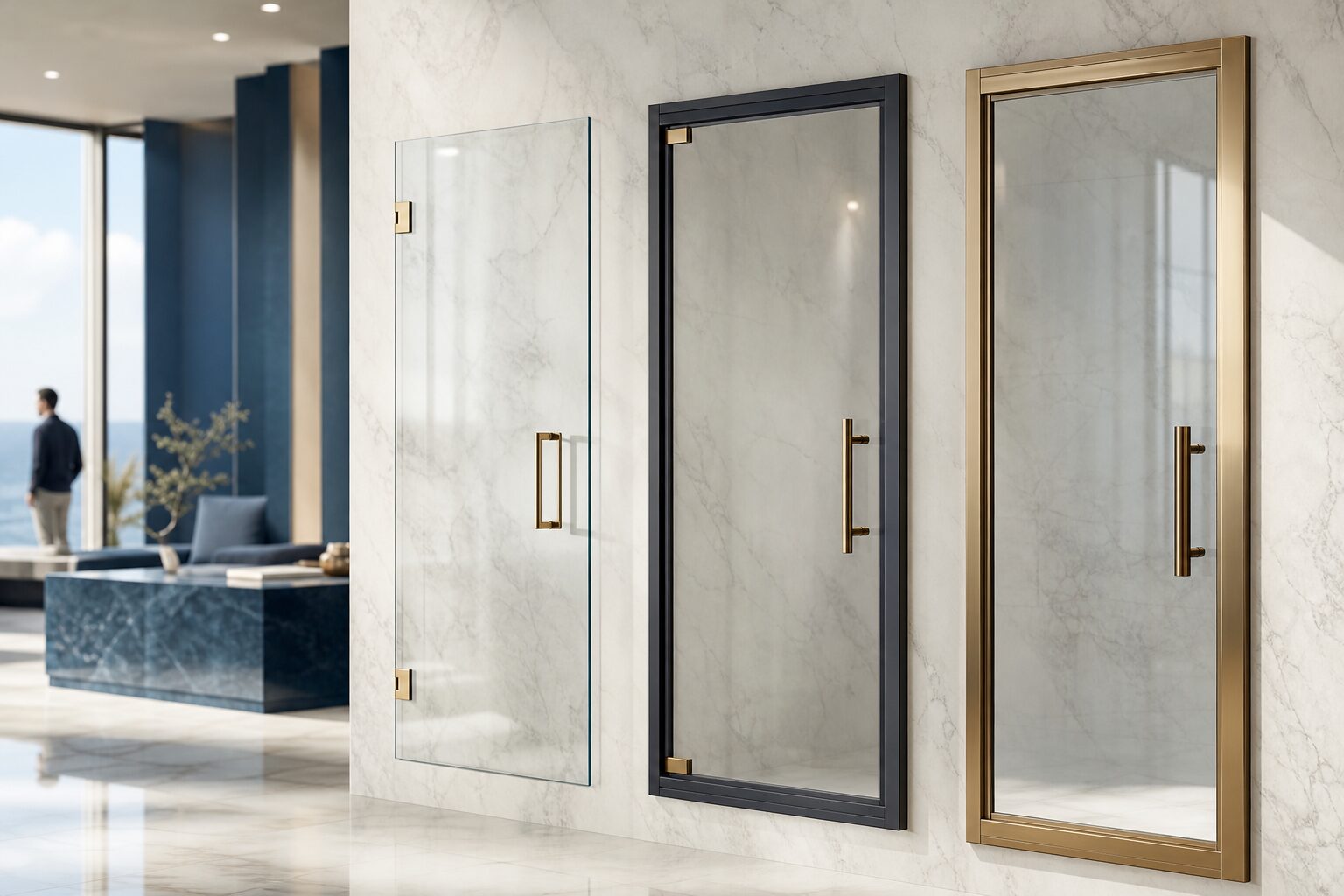
The distinction comes down to how much metal framework supports the glass. Frameless enclosures use minimal to zero framing, just heavy-gauge glass panels held by stainless steel or chrome hinges and clamps at the edges. Semi-frameless designs add a vertical support rail down the center or along the leading edge of the door, creating a hybrid aesthetic. Framed enclosures wrap aluminum or steel frames around the entire perimeter of the glass, creating the traditional look you see in many residential bathrooms.
The visual difference is immediate: frameless reads as open and minimal, semi-frameless splits the difference, and framed creates defined geometric structure.
| Enclosure Type | Glass Thickness | Metal Framework | Typical Cost Range | Maintenance |
|---|---|---|---|---|
| Frameless | 3/8″ to 1/2″ | Minimal (hinges, clamps only) | Higher | More frequent cleaning |
| Semi-Frameless | 3/8″ | Center rail or edge support | Mid-range | Moderate |
| Framed | 1/4″ to 3/8″ | Full perimeter frame | Lower | Frame requires regular cleaning |
Why does glass thickness matter so much?
Thicker glass is structural. Frameless doors rely entirely on the glass itself to span the opening and resist water pressure, so they demand 3/8-inch minimum, often 1/2-inch for wider openings or taller panels. Thinner glass flexes and can feel unstable. Semi-frameless can work with 3/8-inch because the center rail carries some load. Framed enclosures can use 1/4-inch glass because the aluminum frame does the heavy lifting.
Thicker glass also reads as premium. It has weight, solidity, and a refined edge quality that thinner glass simply cannot match. If you’re building a shower that feels like a luxury hotel, glass thickness is non-negotiable.
What about hardware finishes and their role in the overall aesthetic?
Hardware finish is where your design intention becomes visible. Polished chrome and brushed nickel are the workhorses, clean, versatile, and they pair with nearly any tile or countertop palette. Oil-rubbed bronze and matte black finishes anchor more contemporary or transitional spaces. Stainless steel reads industrial-modern. Brass and warm gold accents are having a moment in refined residential luxury, and they work beautifully against marble or neutral stone.
The finish you choose should echo your bathroom faucet, towel bar, and any other metal details in the room. Mixing finishes is fine when intentional, but random metal choices read as unfinished.
Frameless enclosures showcase hardware more prominently because there’s less metal overall, every hinge and clamp is visible. Semi-frameless and framed options distribute hardware visually, so a less expensive finish can still look polished. If your budget is tight but you want frameless, investing in a better hardware finish helps compensate.
How do costs actually break down, and when does each option make sense?
Frameless enclosures typically run 40 to 60 percent higher than framed options for the same opening size. The premium covers thicker glass, precision fabrication, and higher-grade hardware. Semi-frameless typically sits 20 to 35 percent above framed pricing. Framed is the budget anchor, but “budget” doesn’t mean cheap, a well-designed framed enclosure with quality glass and finishes reads as intentional, not compromised.
Choose frameless if you have the budget and your bathroom layout supports it. Open floor plans, minimal visual clutter, and neutral tile palettes all showcase frameless elegance. Choose semi-frameless if you want the frameless look but need structural support for a wider opening or if your budget sits in the mid-range. Choose framed if you’re working within tight budget constraints, if your bathroom has strong geometric tile patterns that benefit from frame structure, or if you’re installing a smaller enclosure where the frame doesn’t visually dominate.
One honest note: frameless requires more frequent cleaning. Soap residue and water spots show immediately on large expanses of unsupported glass. If maintenance falls low on your priority list, semi-frameless or framed may suit you better.
What about installation complexity and long-term durability?
Frameless installation demands precision. The opening must be square and plumb within tight tolerances, or the glass won’t hang correctly and seals will fail. Semi-frameless is more forgiving. Framed is the most forgiving because the frame itself can accommodate minor imperfections in the rough opening.
Durability across all three styles is excellent when properly installed. The real difference emerges in maintenance. Frameless and semi-frameless rely on silicone seals at the edges; these typically last 5 to 10 years before they need resealing. Framed enclosures have seals too, but the frame also collects water and debris where the frame meets the glass, creating maintenance points. None of this is a deal-breaker, it’s just the reality of how water behaves in each design.
Glass itself is durable across all three. Tempered glass (required for safety in all shower enclosures) is heat-treated to resist thermal shock and impact. It won’t spontaneously shatter, though rare edge damage can cause failure. Hardware, hinges, clamps, handles, should be stainless steel or solid brass for longevity. Cheap plated hardware corrodes and fails within a few years.
How do these styles fit into different bathroom design directions?
Frameless is the go-to for minimalist, contemporary, and modern luxury aesthetics. It pairs beautifully with clean-lined vanities, marble or large-format tile, and neutral color palettes. It also works in transitional spaces where you want visual lightness without cold modernism.
Semi-frameless bridges traditional and contemporary. It suits transitional bathrooms, spa-inspired spaces, and situations where you want some visual structure without the weight of a full frame.
Framed enclosures anchor traditional, transitional, and eclectic bathrooms. They work with subway tile, smaller mosaic patterns, and warmer color schemes. A framed enclosure with oil-rubbed bronze hardware and marble accents reads as timeless rather than trendy.
When you’re planning shower installation options, consider the entire bathroom envelope. The enclosure should feel like one piece of a coherent design, not an afterthought.
What about glass type and tinting options?
Clear glass is the standard and the most luxurious, it showcases tile, stone, and the interior of the enclosure without visual interruption. Frosted or textured glass offers privacy and hides water spots, but it reads less refined and can make small bathrooms feel smaller. Tinted glass (gray, bronze, or blue) is trending in high-end residential work; it adds sophistication and helps mask soap residue, but it’s a commitment, you’re living with that color choice for 10 to 15 years.
For a timeless aesthetic that won’t feel dated in five years, clear glass is the safest choice. Frosted works if privacy is a genuine need. Tinted is a design statement, own it or skip it.
Frequently Asked Questions
Is frameless glass really safer than framed?
All shower glass must be tempered by code, so safety is equivalent across all three styles. Tempered glass is designed to crumble into small, relatively harmless pieces if it breaks, rather than shattering into sharp shards. The difference is structural integrity during normal use, frameless requires thicker glass to span the opening safely, but that’s about performance, not safety.
Can I retrofit a frameless enclosure into an older bathroom?
Yes, but the rough opening must be square and plumb within tight tolerances. Older bathrooms often have slightly out-of-square openings, which can be corrected with careful framing work before the enclosure is installed. This adds cost. Semi-framed or framed enclosures are more forgiving of minor imperfections, making them a practical choice for renovation work in older homes.
How often do I need to reseal a frameless or semi-frameless enclosure?
Silicone seals typically last 5 to 10 years depending on water quality, ventilation, and cleaning habits. Hard water and poor ventilation accelerate degradation. Resealing is straightforward and inexpensive, remove the old caulk, clean the joint, and apply new silicone. Plan on this as routine maintenance, not a failure of the enclosure itself.
What’s the best way to keep a frameless door looking clean?
Squeegee the glass after each shower to prevent water spots and soap residue buildup. For weekly cleaning, use a glass cleaner or a 50/50 vinegar-and-water solution with a microfiber cloth. Avoid abrasive scrubbers that can scratch the glass. If you have hard water, a water softener or a rinse with distilled water helps prevent mineral deposits.
Do semi-frameless enclosures offer the same open feel as frameless?
Not quite, but they come close. The center rail or edge support is visible, so the visual effect is less minimalist than true frameless. However, the difference is subtle, and many people find semi-frameless offers the best balance of aesthetics, structural performance, and cost.
Can I use a framed enclosure in a luxury bathroom design?
Absolutely. A framed enclosure with quality glass, a refined hardware finish, and thoughtful tile or stone work reads as intentional and elegant. The frame provides visual structure that complements certain design directions. Don’t assume frameless is always the luxury choice, it’s one choice among three, each with its own aesthetic merit.
