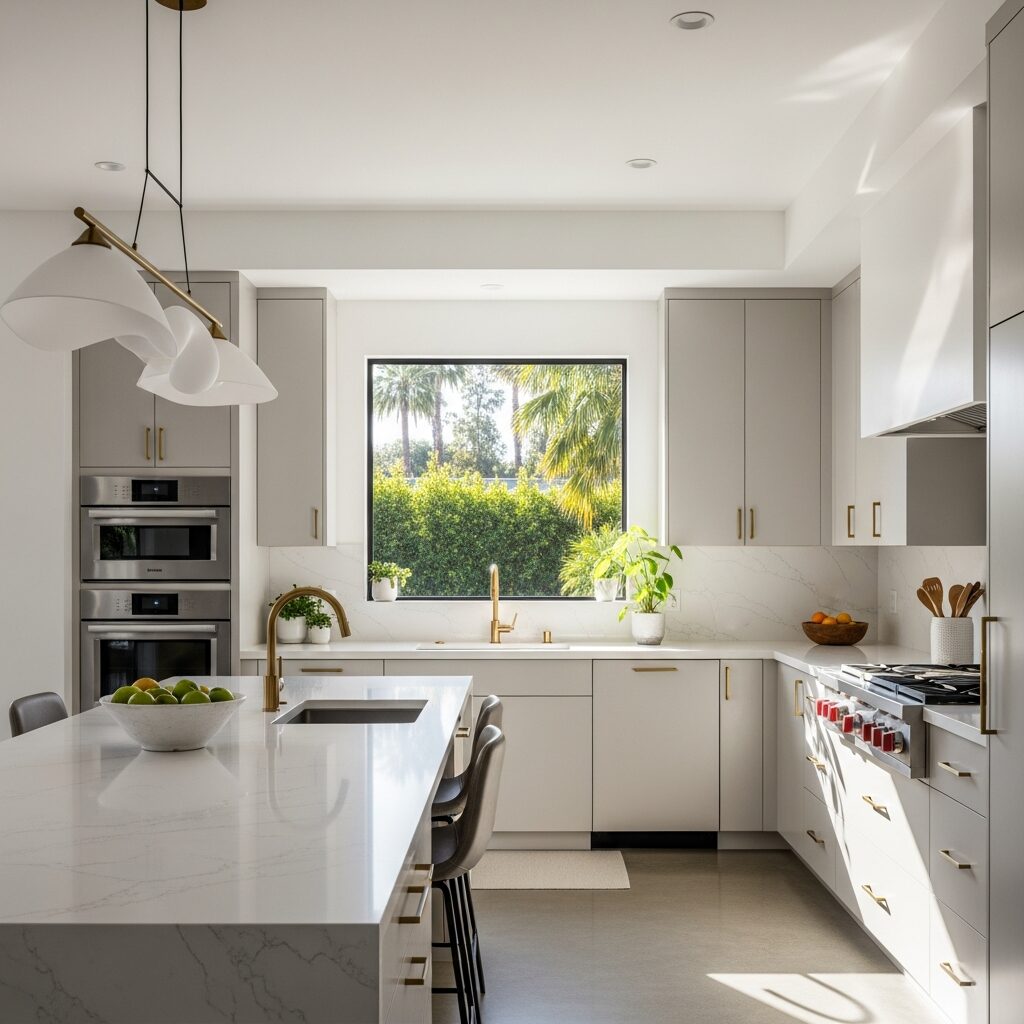
Quartz vs. Porcelain: Choosing Countertops for Your Modern Kitchen Renovation
In any modern kitchen renovation, the countertop is more than just a surface; it’s the centerpiece of the room’s design and the workhorse of your culinary life. For homeowners today, the choice often comes down to two advanced, engineered materials: quartz and porcelain. Both offer a significant leap in performance over traditional materials, but they possess distinct characteristics that make them suitable for different needs and aesthetics. As specialists in high-end kitchen remodeling, we’ve spent decades mastering the nuances of these materials, from fabrication to final installation. This guide provides an in-depth, technical comparison to help you make an informed decision for your investment.
This is not just a style choice; it’s a decision about durability, maintenance, and long-term value. Understanding the core differences in the quartz vs porcelain countertops debate is the first step toward a kitchen that is not only beautiful but also built to last. We’ll explore their material science, design potential, and the critical role professional installation plays in unlocking their full performance.
Quartz vs. Porcelain: The Ultimate Durability Showdown for Your Kitchen Renovation
When you invest in a complete kitchen renovation, you expect materials that can withstand the rigors of daily life. Both quartz and porcelain are renowned for their toughness, but their durability profiles differ based on their unique compositions. Understanding these differences is key to selecting a countertop that aligns with your household’s lifestyle.
Scratch and Impact Resistance: A Material Science Deep Dive
Quartz countertops are an engineered stone composite, typically containing around 90-93% crushed natural quartz crystals—one of nature’s hardest minerals—bonded together with polymer resins and pigments. This composition gives quartz countertops exceptional durability and a Mohs hardness rating of approximately 7. The resin content provides a slight degree of flexibility, which makes the surface more resistant to chipping or cracking from blunt impacts, such as a dropped pot, compared to more rigid materials.
Porcelain, on the other hand, is a ceramic product made from refined clay and powdered minerals fired at extremely high temperatures (over 2200°F). This process, known as sintering, creates a dense, vitrified, and incredibly hard surface with a Mohs rating between 6 and 7. The surface of porcelain is exceptionally resistant to scratches from knives and other utensils. However, due to its rigid structure, a thinner porcelain slab can be more susceptible to chipping on an exposed edge if subjected to a sharp, heavy impact.
Heat Tolerance and Thermal Shock Properties
One of the most significant functional differences between these two materials lies in their heat resistance. This is a critical consideration for any active kitchen. Because porcelain is forged in extreme heat, it possesses superior heat tolerance. You can place a hot pan directly from the stovetop onto a porcelain countertop without fear of scorching, burning, or discoloration. It is virtually immune to thermal shock, making it one of the best heat resistance kitchen countertops available.
Quartz countertops durability, while excellent in many respects, has a notable vulnerability to high heat. The polymer resins that bind the quartz crystals can be damaged by temperatures above 300°F. Placing a hot pot directly on quartz can cause permanent discoloration or scorching, and rapid temperature changes can even lead to cracking. We always recommend the use of trivets and hot pads on quartz surfaces to protect your investment.
Porosity and Stain Resistance: Protecting Your Investment
Here, both materials excel. Unlike natural stone like marble or granite which requires regular sealing, both quartz and porcelain are non-porous. For quartz, the resins fill any voids between the quartz particles, creating an impenetrable surface. For porcelain, the sintering process creates a glass-like surface with a water absorption rate of less than 0.5%. This means neither material will harbor bacteria or absorb liquids like wine, coffee, or oil, making them exceptionally hygienic and stain-resistant. This low-maintenance quality is a primary reason homeowners gravitate toward these advanced countertop materials.
Achieving Aesthetic Excellence: Design Versatility in Quartz and Porcelain Countertops
Beyond performance, your countertops are a primary aesthetic statement. Both engineered stone and ceramic countertops offer a vast array of design options that were once unimaginable, allowing for true customization in your modern kitchen renovation.
Color Consistency and Pattern Replication
Quartz offers unparalleled consistency. Since it’s a manufactured product, the color, pattern, and particulate distribution are controlled, ensuring that the slab you choose from a sample is exactly what you get. This makes it ideal for large kitchens where multiple slabs are needed, as seams can be matched with near-perfect consistency.
Porcelain leverages advanced digital printing technology to achieve its look. This allows it to realistically mimic the appearance of natural materials like marble, wood grain, or concrete with incredible depth and precision. High-end porcelain slabs can feature veining that runs through the body of the material (known as through-body or full-body porcelain), so the pattern isn’t just a surface print. This allows for beautifully matched veining on waterfall islands and mitered edges.
Edge Profiles and Fabrication Complexity
The workability of the material dictates design possibilities, particularly with edge details. Quartz is easier to fabricate than porcelain. Its composition allows for a wide variety of edge profiles, from simple eased edges to more complex ogee, bullnose, or beveled designs. Porcelain’s hardness and brittleness make it more challenging to cut and shape. While standard edge profiles are certainly achievable, intricate designs require specialized tooling and a highly skilled fabricator to prevent chipping during the process. This fabrication complexity can sometimes add to the overall project cost for porcelain.
Integrating Countertop Choices with Open Concept Layouts
In modern home design, the kitchen is often the hub of an open-plan living space. The choice of countertop material plays a huge role in creating a cohesive aesthetic. The availability of large-format porcelain slabs (some over 10 feet long) allows for massive, seamless kitchen islands that serve as stunning focal points. This ability to minimize seams is a significant advantage in designing open concept layouts. Furthermore, because porcelain can be produced in very thin profiles, it can be used for full-height backsplashes and even cabinet cladding, creating a sleek, monolithic look that is highly sought-after in contemporary design.
Long-Term Value: Understanding Maintenance and Longevity for Your Remodeled Kitchen
A successful renovation is one that continues to deliver value and performance for years to come. The countertop maintenance comparison between quartz and porcelain reveals that both are excellent low-maintenance choices, but their lifecycle costs and repairability are worth considering.
Daily Cleaning Protocols for Each Material
Maintenance for both surfaces is refreshingly simple. A soft cloth with warm water and a mild, pH-neutral soap is all that’s needed for daily cleaning. Abrasive cleaners or scouring pads should be avoided on both surfaces, as they can dull the finish over time. Thanks to their non-porous nature, aggressive chemical cleaners are simply not necessary.
Sealing Requirements and Stain Prevention
This is a major benefit for both materials: neither quartz nor porcelain ever needs to be sealed. Their non-porous surfaces provide built-in stain protection for life. This eliminates the recurring cost and effort associated with maintaining natural stone, contributing to a lower total cost of ownership over the lifetime of your kitchen.
Repairability and Lifecycle Costs
Durability is high, but no material is indestructible. Repairing a significant chip or crack in either material can be challenging. For quartz, a skilled technician can often fill a small chip with a color-matched epoxy or resin, making the repair nearly invisible. Repairing porcelain is more difficult. If a chip occurs on the edge of a slab where the pattern is only surface-deep, the repair can be noticeable. This is where investing in through-body porcelain pays dividends. The primary lifecycle cost for both materials is the initial investment in the material and professional installation, as ongoing maintenance costs are minimal.
Expert Installation: Why Precision Matters for Advanced Countertop Materials in Southern California
The most advanced countertop material in the world will fail if not installed correctly. The success of your quartz or porcelain countertop installation is entirely dependent on the expertise of the remodeling team. This is not a DIY-friendly project; it requires specialized tools, techniques, and experience.
Substrate Preparation for Optimal Countertop Performance
The foundation for your new countertops is your cabinetry. Before any slab is put in place, our team ensures that all base cabinets are perfectly level, stable, and secure. For large or thin porcelain slabs, which have less flex than quartz, a perfectly flat and continuous substrate is non-negotiable to prevent stress points that could lead to cracks over time. This meticulous preparation is a hallmark of a professional installation and is essential for longevity.
Seamless Integration: Techniques for Large Slab Applications
Handling large slabs, especially the massive formats available in porcelain, requires specialized equipment and manpower to transport and position without causing stress fractures. When seams are unavoidable in a quartz installation, we use advanced software to map the veining and color flow between slabs, creating a seam that is as inconspicuous as possible. These details are what separate an average result from a truly high-end finish.
Ensuring Longevity Through Professional Craftsmanship
Ultimately, the performance, beauty, and lifespan of your new countertops are a direct result of the craftsmanship behind the installation. For homeowners embarking on a southern california kitchen remodeling project in Orange County, Riverside, or San Bernardino, partnering with an experienced team is critical. Our professionals are trained in the specific handling and fabrication requirements of both quartz and porcelain, ensuring every cut is precise, every edge is finished perfectly, and every seam is tight and clean. This commitment to excellence ensures your new kitchen not only looks stunning on day one but performs flawlessly for decades.
Whether you choose the consistent durability of quartz or the unmatched heat resistance and aesthetic mimicry of porcelain, you are selecting a premium material for your home. The right choice depends on your specific priorities for cooking, design, and daily life. Get a Free in-home estimate.
